
Walk around most residential sites and you’ll see the same thing. Skips filling with offcuts, packaging and damaged materials. Pallets of blocks and plasterboard left out in the rain.
Every tonne of that waste is a cost. It’s paid for once as material, again in handling and disposal, and often a third time in rework.
For developers working to tight margins, waste isn’t only an environmental issue. It’s a viability issue. This article looks at how modular construction waste reduction works in practice, where the savings come from, and what it can and can’t change on your scheme.
Key Takeaways
- Ireland’s EPA guidelines state that off-site manufacturing has been shown to reduce residual waste by up to 90% in volumetric building
- Most of the waste saved comes from cutting, packaging, damaged materials and rework
- Factory production makes it easier to plan materials accurately and sort leftovers for reuse or recycling
- Groundworks and excavation still generate soil and stone waste on a modular scheme
- Resource and waste management planning still applies, but there’s less waste to manage on site
How Does Modular Construction Reduce Waste?
Modular construction reduces waste by moving most of the build into a factory. Materials are cut to precise designs, stored under cover and sorted for reuse or recycling. Less activity on site means fewer offcuts, less packaging and less damaged material. Ireland’s EPA guidelines state that off-site manufacturing has been shown to reduce residual waste by up to 90% (EPA).
Where Waste Comes From on a Traditional Site
On a traditional build, waste builds up gradually across the programme. It usually comes from a few familiar sources:
- Cutting and fitting. Blocks, timber, plasterboard and insulation are cut to size on site, and offcuts rarely get used.
- Over-ordering. Materials are often ordered with a margin for error, and the surplus goes in the skip.
- Packaging. Each delivery arrives wrapped, banded or palletised.
- Weather and handling. Materials stored outdoors can be damaged by rain or moved several times before use.
- Rework. When detailing goes wrong, finished work has to be removed and redone.
Rework matters more than it used to. Meeting NZEB standards under Part L relies on careful airtightness and insulation detailing across several trades. When that coordination slips, corrections create both cost and waste.
How Modular Construction Waste Reduction Works
More accurate material planning
Modular homes are designed in detail before production begins. Factories typically work from digital models, so quantities can be calculated closely and materials ordered to match.
The EPA’s guidelines note that manufacturers can produce modular components made to measure. That reduces the over-ordering and leftover stock common on traditional sites.
Less construction activity on site
When completed modules arrive ready to install, much of the cutting, fitting and finishing has already been done. Insulation, plasterboard and internal fit-out are typically installed in the factory.
That means fewer trades on site, fewer deliveries and fewer skips. It also means less disruption for neighbours during the build.
Easier reuse and recycling
A factory has the space and routine to separate leftover materials properly. Metal, timber, plasterboard and packaging can be sorted at source rather than mixed in a single skip.
Clean, separated materials are far easier to reuse or recycle. Mixed site waste is harder and more costly to recover.
Less damaged material
Materials in a factory are stored under cover and handled less often. They aren’t left exposed to Irish weather between delivery and installation.
That protects them from the rain damage and repeated handling that send usable materials to the skip on many sites.
Repeatable design across units
On a multi-unit scheme, modules are often built to the same or similar designs. The same details are repeated under the same conditions, unit after unit.
That consistency reduces the variation that leads to mistakes, corrections and wasted materials. It also makes it easier to see where material use can be tightened across the whole scheme.
What Modular Construction Doesn’t Change
It’s worth being clear about the limits.
Ireland generated 7.9 million tonnes of construction and demolition waste in 2024, and most of it was soil and stone (EPA). Much of that comes from excavation and groundworks.
A modular scheme still needs foundations, drainage and service connections. That site work generates soil and stone in much the same way as any development. Modular construction waste reduction applies mainly to the building itself, not the ground it sits on.
Packaging and transport protection also travel with the modules. These need planning for collection and recycling when modules arrive on site.
What This Means for Your Scheme
For developers, the practical benefits of modular construction waste reduction tend to be:
- Less site waste requiring collection and disposal
- More predictable material requirements, set by a defined specification
- Better opportunities for material recovery and recycling
- Less construction activity and disruption on site
- More consistent quality across multiple units, which reduces rework
Under the EPA’s guidelines, new residential developments of 10 or more dwellings fall into Tier 2, which calls for a more detailed, bespoke Resource and Waste Management Plan (RWMP). Developments of fewer than 10 dwellings fall into Tier 1 and can use a simplified plan.
Either way, a lower volume of construction waste makes the plan easier to deliver on site.
The EPA’s guidelines also note that the decision to build off-site is usually cost-led. Waste reduction is a welcome result, but it sits alongside programme and cost benefits. We cover those in our article on off-site construction benefits.
Building Cleaner With Advanced Space Providers
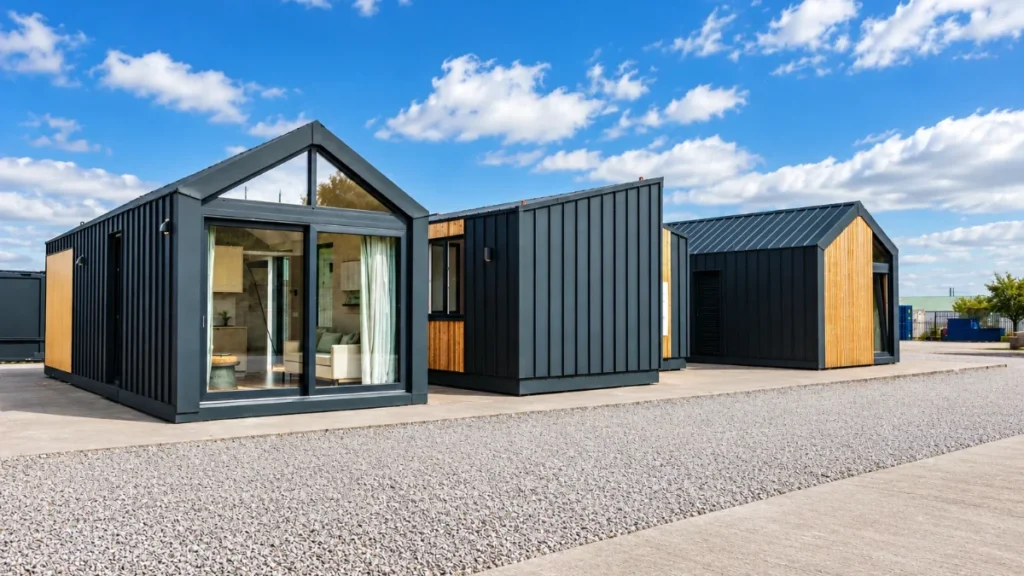
Advanced Space Providers is the exclusive Irish partner of DMD Modular for residential development. Through our Smart Living range, homes are built off-site in a controlled factory environment and delivered ready to install.
DMD’s steel-framed modules are built at its facility in Skawina, southern Poland, and DMD maintains certified environmental and energy management systems. The range includes insulation and lower-carbon material choices, with NZEB performance built into the specification.
A defined factory specification helps establish scope and cost before work begins. The indicative programme is 16 to 20 weeks from permit to keys. To see how a modular project moves from brief to handover, read our guide to modular building process steps.
If you’re planning a residential development, an early conversation can show how much waste, programme time and cost uncertainty a modular approach could take out of your scheme. Share your location, intended capacity and target programme, and we’ll take it from there.
Learn more about the Smart Living residential range and talk to the team.