
Building a home in Ireland now takes twice as long as it did a decade ago.
According to the Central Bank of Ireland’s Quarterly Bulletin Q3 2026, the average duration from the initial lodgement of a planning application to completion is now four years, compared to two years a decade ago.
For a residential developer financing a scheme on a construction loan, every additional week on site has a direct and measurable cost.
Off-site construction benefits are increasingly relevant in this environment. This article sets out what those benefits are, how they compare to traditional build, and what developers evaluating the method need to understand before their next project.
Key Takeaways
- Off-site construction can reduce project timelines by 20 to 50% compared to traditional build according to industry research
- Factory production runs parallel to site preparation, compressing the post-permit programme significantly
- Factory-defined specification helps establish cost and scope before construction begins
- NZEB-level performance is designed into the factory specification rather than coordinated across trades on site
- Advanced Space Providers is the exclusive Irish partner of DMD Modular, working with residential developers across Ireland
What Is Off-Site Construction and How Does It Work in Ireland?
Off-site construction involves manufacturing building components or complete volumetric modules in a controlled factory environment, then transporting them to site for installation.
Unlike traditional on-site build where each trade works sequentially and is exposed to weather, labour availability and site disruption, the factory process runs to a defined programme with consistent quality controls.
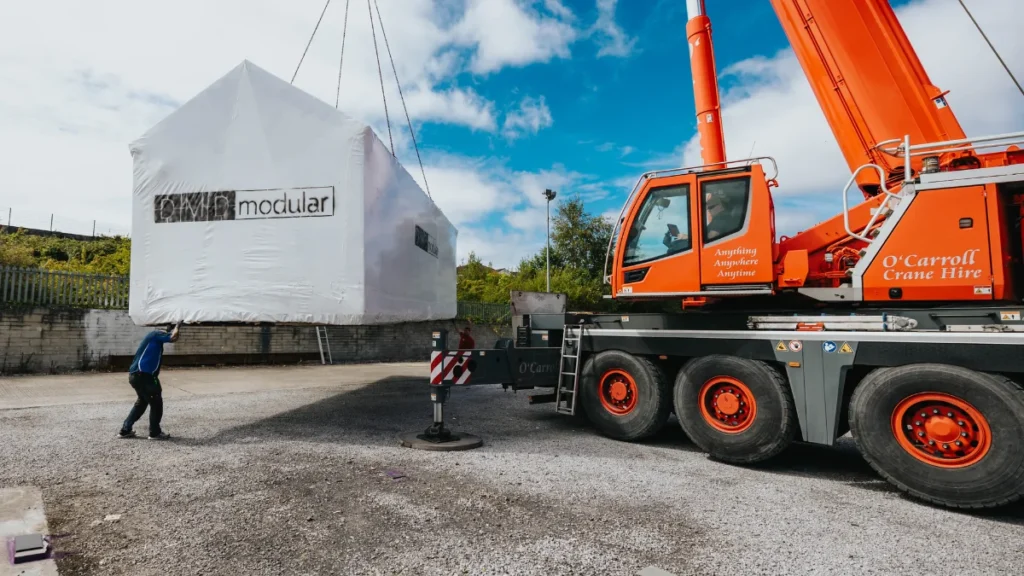
For residential developers in Ireland, off-site construction offers a practical route to faster, more predictable delivery without sacrificing design flexibility or compliance standards.
What Are the Main Off-Site Construction Benefits for Irish Developers?
The benefits most relevant to Irish residential developers fall into four areas: programme speed, cost certainty, labour efficiency and energy performance.
1. Programme speed
Factory production runs in parallel with site preparation rather than after it. While groundworks and foundations are being completed on site, the modules are already being built in the factory.
McKinsey’s research on modular construction found that modular projects were completed 20 to 50% faster than traditional on-site builds.
For a developer whose construction loan is running from the day the permit is granted, a faster post-permit programme directly reduces financing costs and brings forward the point at which revenue is generated.
On a scheme with a 12 to 36 month loan term, cutting the construction period by even three to four months has a meaningful impact on the overall project return.
2. Cost certainty
A factory-defined specification helps establish scope and cost before construction begins so there are fewer variations driven by weather delays, trade substitutions or on-site rework. The specification is agreed, the factory builds to it, and the module that arrives on site reflects what was priced.
For Irish developers operating close to viability thresholds, that certainty is meaningful. It does not eliminate all cost risk, but it removes a significant category of the unpredictable costs that consistently erode margins on traditional builds at the delivery stage.
3. Labour efficiency
On-site work is reduced to installation and connection rather than the full build sequence. For a sector where 76% of the 159 construction firms surveyed reported an increase in labour costs in Q2 2026 according to the CIF Q3 2026 Construction Outlook Survey, reducing on-site labour dependency has a direct impact on project viability.
Fewer workers on site for a shorter period also means reduced exposure to site safety incidents, which carry their own programme and cost implications.
4. Energy performance
One of the key off-site construction benefits is that NZEB-level energy performance can be designed into the factory specification from the outset.
On a traditional build, achieving Part L compliance requires careful coordination across multiple trades throughout the construction process. Poor detailing at junctions, penetrations or the building envelope is a documented source of failed airtightness tests and costly rework late in the programme.
Off-site construction resolves these details in a controlled factory environment before a module reaches site. The thermal envelope, insulation levels and airtightness specifications are consistent across every unit because they are manufactured to the same quality management process.
If you are evaluating off-site construction for a residential scheme in Ireland, consider discussing your project brief with the ASP team first. Early conversation shapes better outcomes.
Does Off-Site Construction Meet Irish Building Regulations?
Yes. Modular and off-site homes in Ireland must comply with the same building regulations as traditional builds, including structural integrity, fire safety, energy efficiency under Part L and NZEB standards.
The method of construction does not exempt a building from regulation.
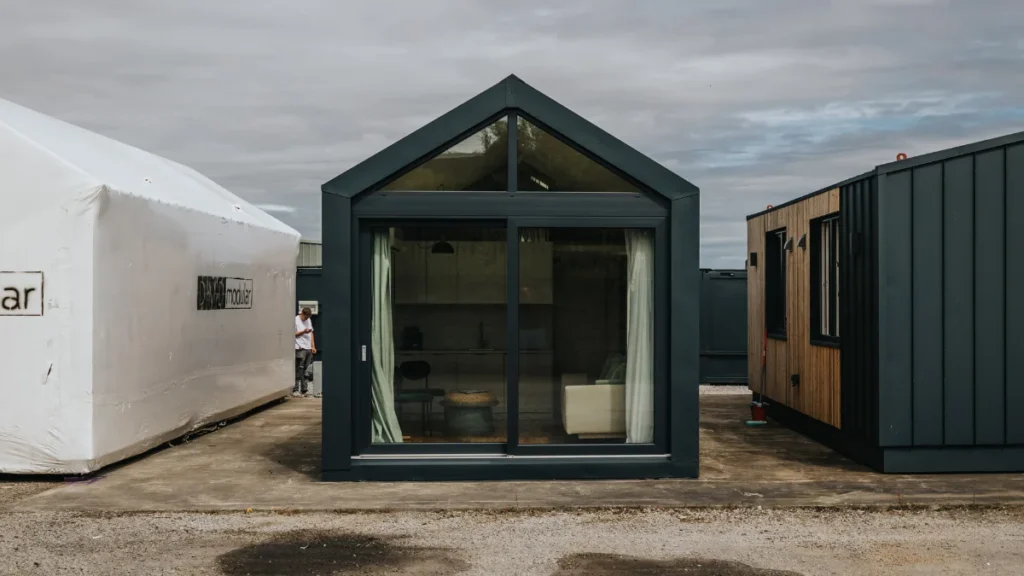
It changes where compliance is achieved, from a site with multiple trades to a factory with controlled processes and quality management systems.
How Does Off-Site Construction Compare to Traditional Build in Ireland?
| Traditional On-Site Build | Off-Site Modular Construction | |
|---|---|---|
| Programme | Sequential, weather-dependent | Factory and site run in parallel |
| Timeline reduction | Baseline | 20 to 50% faster overall (industry estimate) |
| Cost certainty | Exposed to variations and rework | Factory specification agreed before build |
| Labour dependency | High on-site trade requirement | Most labour moved to factory |
| NZEB compliance | Coordinated across trades on site, risk of rework | Built into factory specification |
| Weather exposure | Significant programme risk | Minimal, factory-controlled environment |
| Quality control | Variable, site-dependent | Consistent, ISO-certified factory process |
| On-site disruption | Extended, multiple trades | Short installation window |
The off-site construction benefits go beyond speed alone. It is about where risk sits in the programme.
Traditional on-site construction concentrates risk at the delivery stage. Weather delays, trade availability and on-site coordination all affect the programme after the construction loan is running.
Cost overruns at this stage are difficult to absorb on schemes already priced tightly.
Off-site construction shifts risk to the design and specification stage. The programme is driven by the factory schedule.
What arrives on site is a completed module, not a sequence of trades to coordinate. The trade-off is that the design and specification decisions that would normally evolve during a traditional build must be made earlier and more precisely.
Smart Living Residential by Advanced Space Providers
Advanced Space Providers is the exclusive Irish partner of DMD Modular for residential development. Our Smart Living residential range covers layouts suitable for private buyers, residential developers, build-to-rent schemes and co-living communities.
- Homes are built off-site in DMD Modular’s factory and delivered to site ready to install.
- The steel-framed structure is designed for a 40 to 50 year lifespan.
- Our homes are built to exceed Ireland’s NZEB (Nearly Zero Energy Building) requirements with high-performance insulation and reduced carbon footprint.
- The indicative programme runs 16 to 20 weeks from permit to keys.
- The range is designed to support different configurations and finishes.