
Ireland’s weather needs no introduction.
Storm Éowyn made landfall in January 2025 with record-breaking wind gusts of 184 km/h, left 768,000 homes and businesses without power and cost insurers over €301 million, making it the most expensive weather event in Irish history.
For the construction industry, the impact was immediate. Sites shut down. Deliveries stopped. Programmes slipped.
The weather impact on modular construction is fundamentally different from what happens on a traditional build site. This article explains why, what the limits of that protection are, and what Irish developers evaluating modular construction need to understand before making a decision.
Key Takeaways
- 80 to 90% of modular construction happens in a factory, protected from weather-related delays
- On-site elements including foundations, groundworks and crane operations remain weather-dependent
- Factory-controlled manufacture protects the programme from the weather disruption that commonly pushes traditional builds over budget
- Steel-framed modular construction resists rot, warping and moisture damage associated with Ireland’s damp climate
Does Modular Construction Eliminate Weather Delays in Ireland?
Modular construction does not eliminate weather delays entirely, but it removes the majority of weather exposure from the construction process.
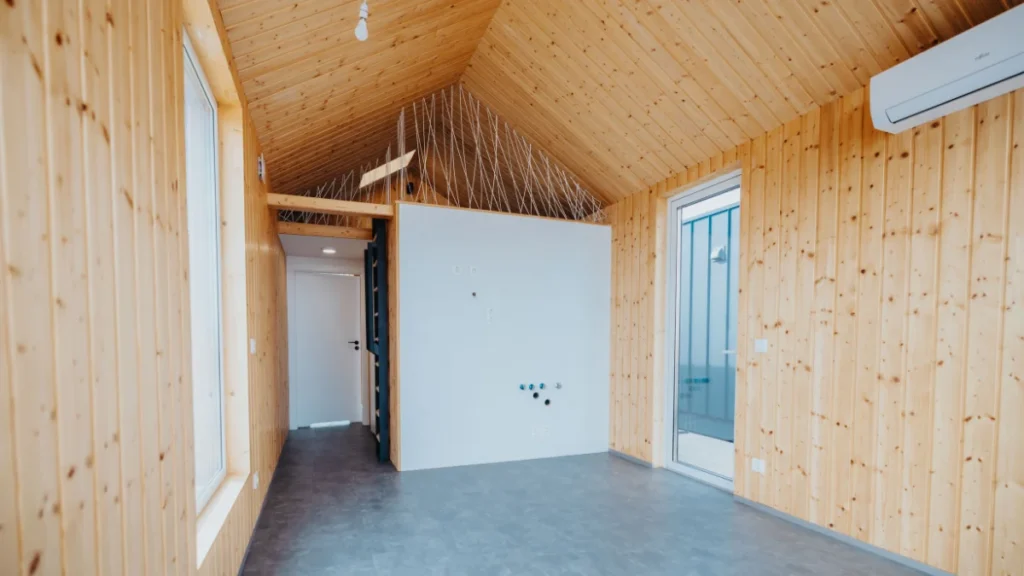
Because 80 to 90% of the build happens in a climate-controlled factory before a module reaches site, the phases most vulnerable to Irish weather, structural framing, internal fit-out, insulation, airtightness detailing, mechanical and electrical installation, are completed in a protected environment.
What remains weather-dependent is the on-site phase: foundations, groundworks, crane lifts and final connections.
Why Weather Is a Bigger Problem for Traditional Builds Than Developers Price In
A 2024 report from equipment supplier Aggreko, Building in Resilience: Weather-proofing European Construction in a Changing Climate, surveyed 850 construction managers across 11 European countries. All respondents in Ireland had experienced a weather-related delay of some kind in the previous year.
For a developer financing a scheme on a construction loan structured over 12 to 36 months, a weather-related programme delay does not just push back the completion date. It adds directly to financing costs.
A site shut down for two weeks in January because of storm damage or waterlogged ground conditions does not pause the loan. It extends the period over which interest accumulates on the full drawn amount.
Understanding the weather impact on modular construction is therefore important when assessing the financial risks of a residential development, particularly when loan terms and completion dates leave little room for delays.
Plus, Ireland’s weather is not becoming more predictable. The Irish Times reported in January 2026 that Ireland’s electricity grid, transport network and housing stock were built for a different climate, and that extreme weather events are increasing in frequency and intensity.
Construction programmes built around traditional on-site methods carry that risk without a structural way to reduce it.
Weather Impact on Modular Construction: What the Factory Environment Actually Protects
When modular construction moves the build into a factory, it removes a specific and consequential category of risk. Here is what changes:
Structural framing and fit-out
In traditional construction, timber framing exposed to prolonged rain can absorb moisture before it is enclosed, creating conditions that lead to swelling, warping and, in persistent cases, mould. Steel-framed modular construction eliminates this category of risk.
The frames are manufactured in a dry, controlled environment. There is no rain damage, no moisture absorption into structural elements and no cold-weather curing problems for adhesives or concrete elements used internally.
Airtightness and insulation
NZEB compliance under Part L building regulations depends heavily on achieving consistent airtightness across the building envelope. On a traditional build, this requires precise coordination and detailing across multiple trades working sequentially on site, in conditions that vary with the weather. In a factory, the thermal envelope and airtightness measures are built into the specification and applied under controlled conditions, consistently, across every module.
The result is more reliable performance against the NZEB standard that all new Irish homes must now meet.
The weather impact on modular construction also extends to quality control. By completing insulation and airtightness detailing indoors, manufacturers can reduce the risk of weather exposure affecting these critical stages of the build.
Programme certainty
Factory production does not shut down because of a storm.
The Munich Re 2025 Ireland construction trends report noted that modular construction reduces project timelines by 20 to 50% compared to traditional build, with fewer delays caused by poor weather conditions among the primary reasons cited.
If you are evaluating modular construction for a residential scheme and want to understand how the factory programme maps onto your specific site and timeline, let’s start with a conversation.
What Remains Weather-Dependent in Modular Construction
Being clear about what modular construction does not protect against is as important as understanding what it does.
Foundations and groundworks. The concrete foundations, groundworks, utility trenching and site preparation all happen on site before the modules arrive. These phases are fully exposed to Irish weather conditions. A wet winter or a site with poor drainage can delay this phase in the same way it would on a traditional build.
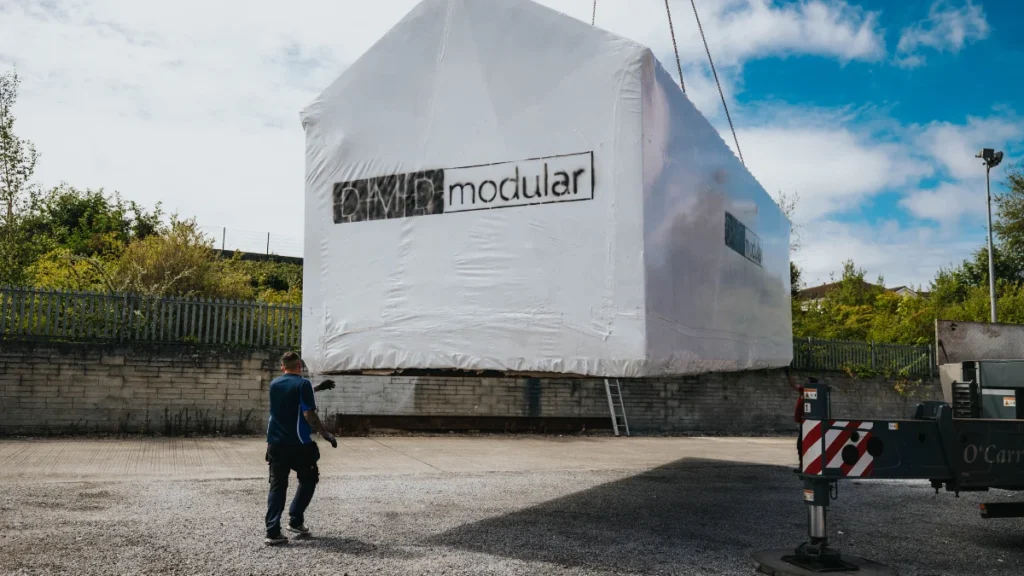
Crane operations. Setting modules onto foundations requires crane lifts. High winds and severe storms halt crane operations. Most modular manufacturers specify maximum wind speed limits for safe crane operations during installation. For a developer, this means the installation phase, while short, needs to be planned with weather windows in mind.
Site access. Heavy transport trucks delivering modules to site need firm ground access. Prolonged rain and mud can restrict access, particularly on rural or undeveloped sites in Ireland. This is worth factoring into programme planning, particularly for winter deliveries.
Any assessment of the weather impact on modular construction should account for these remaining site constraints, particularly when scheduling groundwork, deliveries and installation during Ireland’s wetter months.
The critical distinction is one of proportion. A traditional build exposes the entire construction programme to weather risk over months. Modular construction compresses the weather-dependent on-site phase to foundations, crane operations and connections, which typically take days to weeks rather than months.
How DMD Modular’s Factory Programme Handles the Irish Climate
The Smart Living residential range delivered in Ireland by Advanced Space Providers through its exclusive partnership with DMD Modular is built in a state-of-the-art manufacturing facility in Skawina, southern Poland. The factory spans over 11,500 square metres and produces up to 80 modules per month under quality management systems.
The steel-framed modules are designed for long-term durability in varied European climates, with the structural frame engineered to withstand transport, crane lifts and the on-site stresses of installation.
Steel does not rot or swell like timber, and with appropriate protective coatings and detailing is well suited to Ireland’s damp and wind-exposed conditions.
The range is NZEB-compliant with insulation built into the factory specification. For an Irish developer, this means the NZEB performance standard is achieved through a controlled manufacturing process rather than through on-site coordination across trades in variable conditions.
The indicative programme runs 16 to 20 weeks from permit to keys. That programme is protected from weather disruption for its factory-controlled majority, giving developers a more reliable foundation for their loan term and completion timeline than a traditional on-site build can typically offer.
Built for Ireland. Built Away from Ireland’s Weather
For Irish developers who have seen traditional builds disrupted by wet winters, storm damage or waterlogged sites, the factory-controlled model changes the risk profile of a residential project in a practical and measurable way.
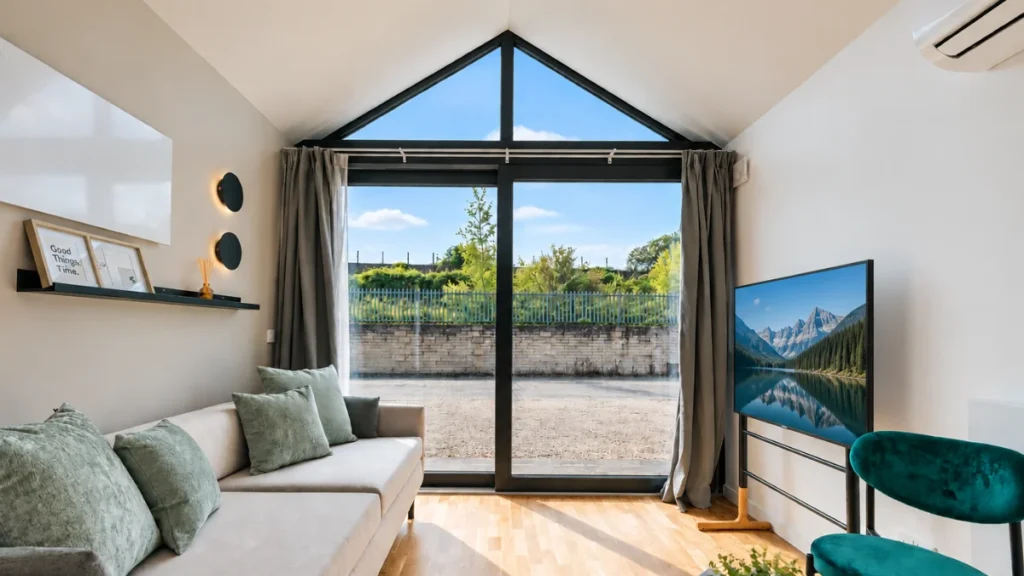
Advanced Space Providers delivers the Smart Living residential range across Ireland as the exclusive Irish partner of DMD Modular. The modules arrive on site having been fully framed, insulated and finished in a factory, protected from the weather conditions that most commonly push Irish construction programmes off schedule.
Planning a residential development in Ireland? Talk to the ASP team to explore the Smart Living range, discuss your site requirements and see how modular construction could fit your project timeline.